“All the statistics in the world can’t measure the warmth of a smile.”
– Criss Jami, Killosophy
Correlation
What is correlation?
It is a mutual relationship or connection between two or more things.
There are 3 types of correlation:
Positive Correlation: as one variable increases so does the other.
Negative Correlation: as one variable increases, the other decreases.
No Correlation: there is no apparent relationship between the variables.
Steps to input data in the calculator:
Punch in the numbers from the table into the calculator. To do so, you should first change the mode setup into “STAT” instead of “COMP”.
Then, press 2 : A+Bx.
Now, input the data in the table.
Steps to find the average of x and y:
After you’ve in out the data, press AC in your calculator then, press shift 1.
Then press 4 : Var.
After so, you would press 2 for the average of x and 5 for the average of y.
Therefore the answer would be:
Average of x: 168.2
Average of y: 53
What is “Equation of Regression Line”?
It is the estimation of y therefore, it gives us a vision of the graph.
Steps on how to find y:
Press AC in your calculator then, press shift 1.
After so, find the value of A (button 1) and B (button 2).
A = -113.0067446 ≈ -133 ; B = 0.9869604317 ≈ 0.99
Therefore Y = (-133)-0.99x
Steps in finding r:
Press AC afterwards, press shift 1
Next, press 5 : Reg
Then, 3 for r
Therefore your answer should be: 0.8827642465 ≈ 0.88
In conclusion, The height (in cm) and weight (in kg) have a positive strong correlation.
How do I know this?
If r is a positive number and is lesser than 0.5 therefore, it is a positive strong correlation and vice versa. On the other hand, if r is a negative number and is larger than -0.5 therefore, it is a negative strong correlation and vice versa.
Cumulative Frequency
What is “Cumulative Frequency”?
The definition of “Cumulative” is “How much so far”. Cumulative is also defined as a running total of frequencies or can also be defined as the sum of all previous frequencies up to the current point.
In some cases, you are told to make graph based on these frequencies. These graphs are called “Cumulative Frequency Graph” or “OGIVE”.
Box and Whiskers
To draw the “Box and Whiskers”, you would need lower quartile (Q1), Median (Q2) upper quart (Q3), minimum and maximum value of the data.
To find Lower Quartile (Q1), the formula is 1/4(n+1)th.
Formula of the median is 1/2(n+1)th.
To find Upper Quartile (Q3), the formula is 3/4(n+1)th.
For example,
6, 8, 7, 8, 9, 4, 8 → 4, 6, 6, 7, 8, 8, 9 (arranged from the lowest to the highest no.)
Everybody watches weather forecasting. Have you ever think how do they get that information? These are some computers models build on statistical concepts. These computer models compare prior weather with the current weather and predict future weather.
Doctors predict disease on based on statics concepts. Suppose a survey shows that 75%-80% people have cancer and not able to find the reason. When the statistics become involved, then you can have a better idea of how the cancer may affect your body or is smoking is the major reason for it.
“Do not just go through the day without pausing to ponder! You shall only retire wondering.” ― Ernest Agyemang Yeboah
Unit 1: Numbers
In the first lesson of mathematics secondary 3 term 4, we were told to draw this diagram:
Our teacher, Mr, Kichan told us that this would definitely be helpful in the future and he was totally right. Then, 2 days after we then started learning the different types of sequences such as: The arithmetic sequence, quadratic sequence and the cubic sequence. First we are going to talk about arithmetic sequences.
Arithmetic sequence is a sequence of numbers such that the difference between the consecutive terms is constant. An example would be:
the sequence 3, 5, 7, 9, . . . is an arithmetic progression with common difference of 2.
Now, how would you find the nth term. Easy…We have a formula for that! The formula is
Un = U1+(n-1)d
Symbols:
Un=nth term➞?
U1=first term➞3
d=common difference➞2
n=no. of terms➞10
So, in the end you should get:
Un=3+(10-1)(2)
Un=21
Next, we are going to find the sum of the n terms. The formula is Sn=n/2(2U1+(n-1)d)
For example, 6,23,40,57,… find the sum of the 17th term.
You should get, S17 = 17/2(12+16(17)0
= 2414
After Arithmetic sequence, we have quadratic sequences. In a quadratic sequence, the difference between each term increases, or decreases, at a constant rate.
The formulae are:
How would you use this in a formula? Here’s how:
Then, we have cubic sequence. Cubic sequences are characterized by the fact that the third difference between its terms is constant. Here is the formula and how to use it:
We are done with sequences so we are going to talk about law of Indices, exponential equation, approximation and estimations, upper and lower bounds, simple and compound interest.
Law of Indices.
Remember that in 67^9 = x. 67 is the base and 9 is the power, index or so called exponent.
Multiplication law
2^3 x 2^5 = 2^5+x
3^7 x 1/3^x = 3^7 x 1/3^x = 3^7 x 3^-x
2. Division law
2^3/2^2 = 2^3-2 =2
3. Power of Zero
(27^52000/3x^2-x)^0 = 1
Approximation and Estimations:
Significant Figures
a. All non 0’s are s.f.
b. 0 may or may not be s.f.
0’s in the beginning of decimal <1 are not s.f.
0.000120➞3s.f.
0’s in between counting numbers are s.f.
101➞3s.f.
203456➞6s.f.
60007➞5s.f.
Upper and Lower bounds:
Simple Interest:
The formula of simple interest is:
I = Prn/100➞160
p = principal amount➞400
r = rate of interest➞8%
n = period of time➞?
This is an example on how to use this equation:
160 = 400 x 8 x t/100
= 5 years
Compound Interest:
Formulas of compound interest are:
F.V. = P.V. (1+r/100t)^tn➞Increasing/Incremental
F.V. = P.V. (1-r/100t)^tn➞Decreasing/Diminishing
Symbols:
F.V. =future value
P.V. = present value
r = rate of interest (not%)
n = period of time (years)
t = compounded (how many times you will divide in a year)
Ex.
Standard form:
Standard form, also known as a scientific notation, is an easier way for writing numbers that has large numbers or even small numbers. As for an example you can just simply write 20000 as 20 x 10^4 or 0.00026 as 2.6 x 10^-4.
Unit 2: Algebra ( part 1 )
Recall:
10(1 – x/10) – (10 – x) -1/100 (10 – x) = 0.06
10 – x – 10 + x – 1/10 + 1/100x =0.05
-1/10 + 1/100x = 0.05
1/100x =0.05 + 0.1
1/100x/1/100 = 0.15/1/100
x=15
“Completing the square”
Factorisation:
By common factor
2x^2 – 18x = 2x(x – 9)
2. x^2 -8x + 16 = (x – 4)(x – 4)
3. Quadratic formula
x = −b ± √(b2 − 4ac) / 2a
ex. x^2 – 17x +30
a = 1
b = -17
c = 30
17 ± √((-17)2 − 4(1)(30) / 2(1)
x1 = 15 , 12 = 2
Therefore, (x – 15)(x – 2)
Ways to Factorise:
1. Factorising by grouping in pairs.
a. regroup the terms such that each pair has a HCF
2xy + 3yz – 4x – 62
y(2x + 3z) – 2(2x + 3z)
b. extract HCF from each pair.
c. extract the resulting common factor.
(y – 2)(2x + 3z)
2. Difference of two squares
*square number = a number when rooted will result in an interest.
(x^2 – y^2) = (x – y)(x + y)
3. Perfect squares
*perfect squares = algebraic product that can be written in the form of (x + y)^2 or (x – y)^2
(x +/- y)^2 = x^2 +/- 2xy + y^2
4. Quadratic Trinomial
x^2 (monomial)
x^2 + 5 (binomial)
x^2 + 3x + 68 (trinomial)
X^3 +x^2 + 3x + 67 (known as polynomial after 4 terms)
Case no.1:
x^2 – 5x + 75
step 1: x^2 – 5x
Step 2: x^2 – 5x + (b/2)^2 – (b/ 2)^2 – 75
Step 3: x^2 – 5 x + (-5/2)^2 – (-5/2)^2 +75
Your answer should be: (x -5/2)^2 + 68.75
Direct Proportion:
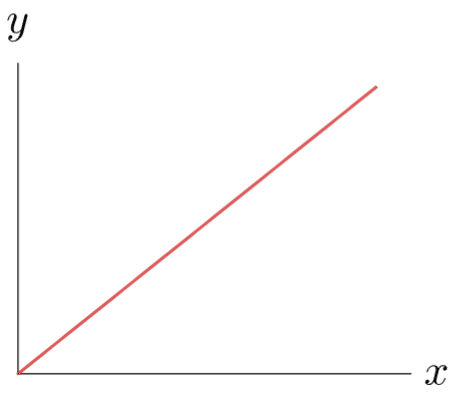
If y is directly proportional to x, then y/x = k or y =kx, where k is a constant and k is not equal to zero.
The graph of y against x is a straight line that passes through the origin.
Inverse Proportion:
If y is inversely proportional to x, then k/x = y or k =xy, where k is a constant and and k is not equal to zero.
The graph of y against x is hyperbola.
Unit 5: Algebra (part 2)
“Algebraic Fractions”
ex.
3/x – 2 – 4/x +1
= 3x + 3 – 4x + 8/(x-1)(x+3)
= 11 – x/(x – 2)(x + 1)
“Variations”
ex.
g = my +mn ➞ my = g – mn ➞ y = g – mn/m
[note that answers must be in their simplest forms]
“Graphing of Linear Inequalities”
Solve the inequality:
2(x – 3) < 5(x+ 3)
a. expand them
2x – 6 < 5x +15
b. put the like terms together in one side.
2x – 5x < 15 + 6
c. add and subtract them
-3x < 21
d. finally divide both sides by -3, so that we know what x is equal to.
x > -7
[note that every time you divide both sides by a negative number, flip the symbol.]
Unit 3: Mensuration
Area of kite:
A = 1/2 x product of diagonals
Volume:
Area of cone:
A = πr^2 + πrl or πr(r + √h^2 + r^2)
Volume of cone:
V = 1/3 (volume of cylinder)
*prism = a solid object with identical ends, flat faces and the same cross section
(volume = area of cross-section x height)
all along its length
hollow
solid
*Pyramid = it’s a pyramid if:
base is a polygon
top points is called the apex
Cone:
has a curved surface
has an apex
has a circular flat surface
*Area of a regular polygon: 1/2(perimeter)(apothem)
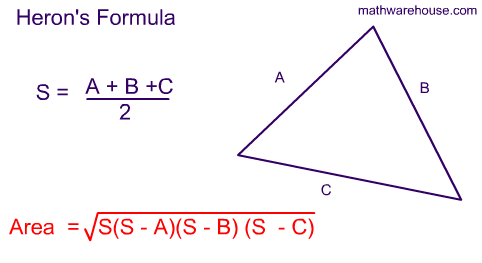
Heron’s formula:
Sine rule:
Area = 1/2 (16)(15) sinѲ°
“External and Internal Angles of Regular Polygons”
sum of interior angles: (n – 2)180 = (4 -2)180 = 360
During our 2 semesters of secondary 3, we competed in the Seamo and WMI maths competitions. To get ready for the competitions. We had to learn other topics that wasn’t in the book. For example, calculus. Besides that, this year, we had our UN exams. Nadya suggested that we should learn topics that we weren’t thought yet. Like sets for example. Sir was kind enough to agree with this brilliant idea. We are so thankful to have a teacher like him. Thank you for reading my e-journal. 💖
“You do not study mathematics because it helps you build a bridge. You study mathematics because it is the poetry of the universe. Its beauty transcends mere things.”
-SDCTM
Everything in this world is made out of math, including you! There would be always hints of maths everywhere you go, in almost every fact of life-in nature all around us, and in the technologies in our hands. Maths is everywhere, you can’t escape it. In this case we would be talking about how maths (geometry and trigonometry) are found in fashion!
Bedazzled Dress
Find the area of the pentagon.
1.First, find the area of the triangle. but, we should find the height before hand.
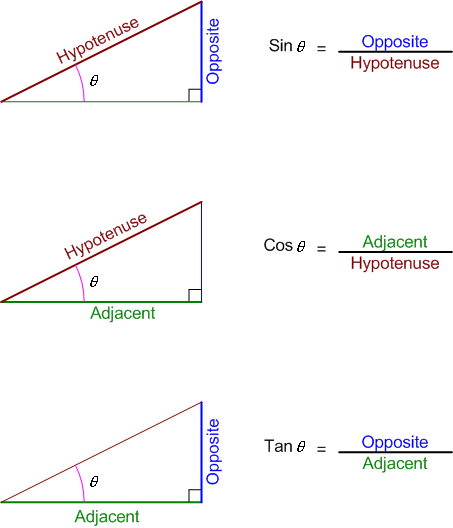
sin=opposite/hypotenuse
sin40=bx/18
bx=18sin40
bx=11.57017697≈12cm
Next, find the base.
cos40=18/x
x=18/cos40
x=23.49733121≈23cm
Now, you can find the area.
bxh/2
(23×12)/2=138cm^2
2. Secondly, find the area of the trapezium. If ac : de is 3 : 1.
If ac=23cm then, de=23/2=11.5cm
(a+b/2)Xh
(23+11.5/2)x10=172.5cm^2
3. Add the area of the triangle with the area of the trapezium.
138cm2+172.5cm2=310.6cm^2
The hidden truth behind dresses.
The circumference of the waist is 50cm, The circumference of bottom of the skirt is 2m and the height of the skirt is 180cm. Find the area of the dress:
Similarity of the dIameter 200:50
Similarity of the whole dress 4:1
similarity of the height 180:45
Use πrl to find the body of the cone
1.Find the big cone.
r=100, l=√(225^2+100^2)
π(100)(√(225^2+100^2))=77352.74829cm^2
2. Find the small cone.
r=25, l=√(45^2+25^2)
π(25)(√(45^2+25^2))=4043.084502cm^2
3. Subtract the big cone from the small cone to find the frustum body.
77352.74829cm^2-4043.084502cm^2=73309.66379cm^2
=7.330966379m^2
≈7.33m^2
In conclusion, even though people hate it we still can find maths applied everywhere around us.
“Mistakes are a fact of life. It is the response to error that counts.”
– Nikki Giovanni
No one is perfect, no one has it all. This is a naked truth we have yet to accept. And even if we could be perfect, it wouldn’t get us to where we really want to go. Because to improve ourselves we should learn from our past, errors and silly mistakes. In this case our errors or silly mistakes are maths questions that might seemed easy and perfect in the start but is really isn’t
Differentiate the following:
QUESTION NO.1
First, expand it!
Ex. expand [ x^2 (5x-2)].
Multiply x^2 by 5x
then, multiply x^2 by -2.
After expanding it you should get this: 27x^51 + 5x^3 – 2x^2 – 3x^51 – 1
Next derive. To do this, you should follow these steps:
Ex. 5x^3
Multiply the power with the coefficient. [ 5×3=15 ]
Subtract one from the power. [ 3-1=2 ]
Repeat!
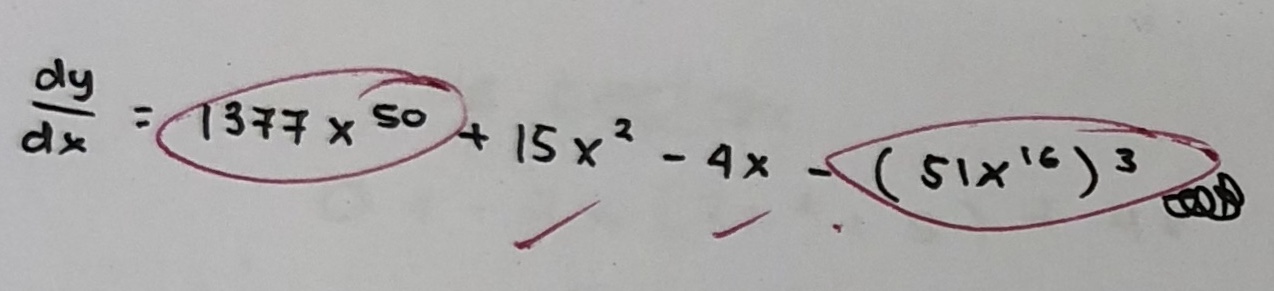
As a result, you should get 1377x^50 + 15x^3 – 4X – 1377x^50. Next simplify and the answer is f'(x)= 15x^2 – 4x.
QUESTION NO.2
First Derive: ( hint: follow the instruction given in question no.1 )
Resultantly you should get: 12x^2 + 4/3 x^-3 + 7x^-1/2
Next Simplify:
Proportionately you should get: 12x^2 + 4/3x^3 + 7/√x
Additional Information: if there’s no x, then leave it as zero and 14√x = 14 x x1/2
QUESTION NO.3
NOW, THIS IS SUCH A SILLY MISTAKE :)) REMEMBER TO ALWAYS CHECK YOUR ANSWERS!!
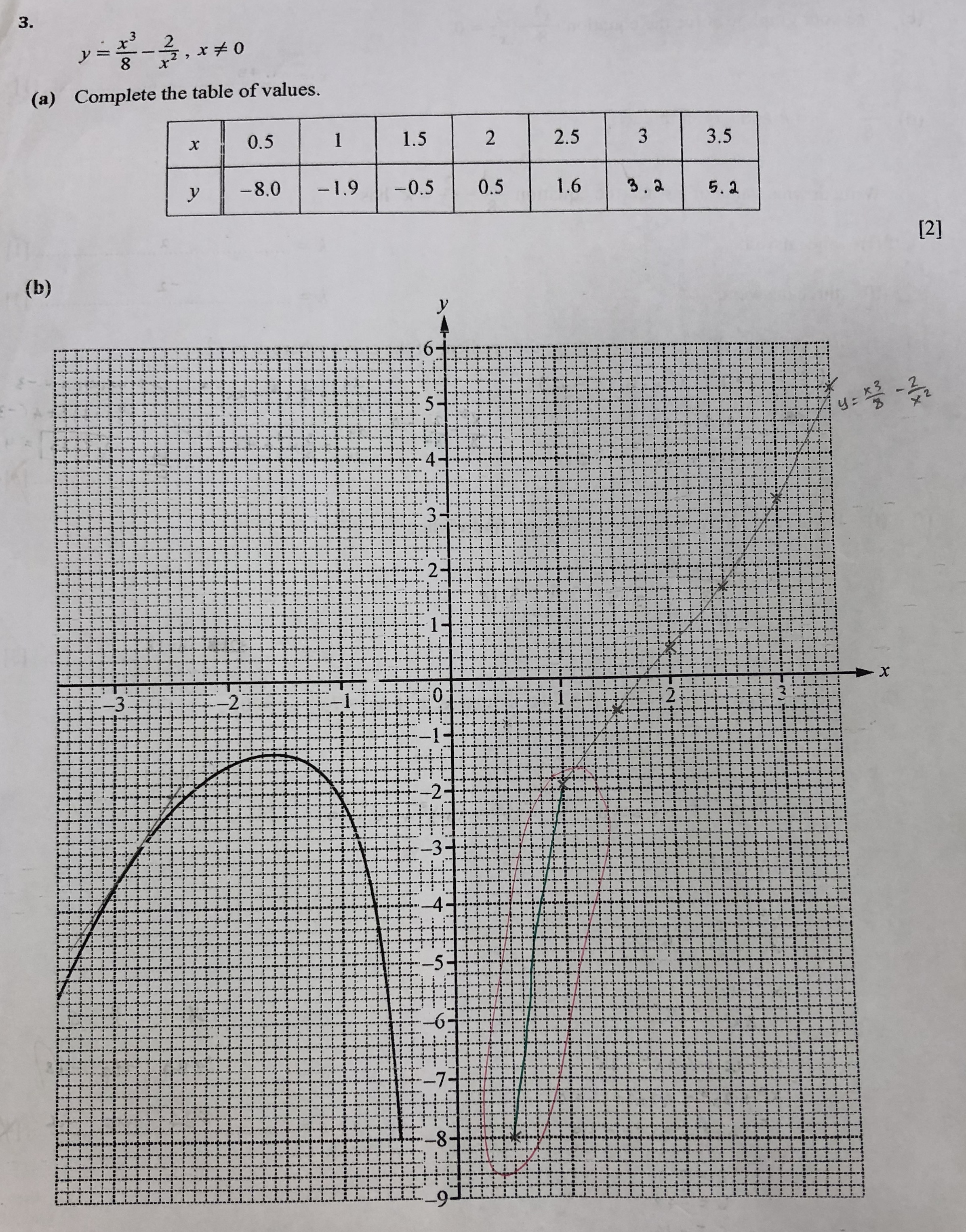
Now, to find the answers (3.2 and 5.2):
First, replace the x in the equation with the number given in the table.
Ex. y = (3)^3/8 – 2/(3)^2
So, y = 3.2
Formerly, do the same thing to the other numbers!
when x is 3, y is 3.2
when x is 3.5, y is 5.2
Last but not least plot them:
To plot them, remember that the x-axis is the horizontal line and the y-axis is the vertical line. Plot a point on where the y and x meet. Ex. (0.5,-8)
2. Repeat with the others. Like shown below:
3. Connect the points and there you go, your finish piece!
Thanks for reading!
And it’s always better isn’t it, when you discover answers on your own? -Veronica Ross
















 Abigail Shannon

